

The Dead Internet Theory
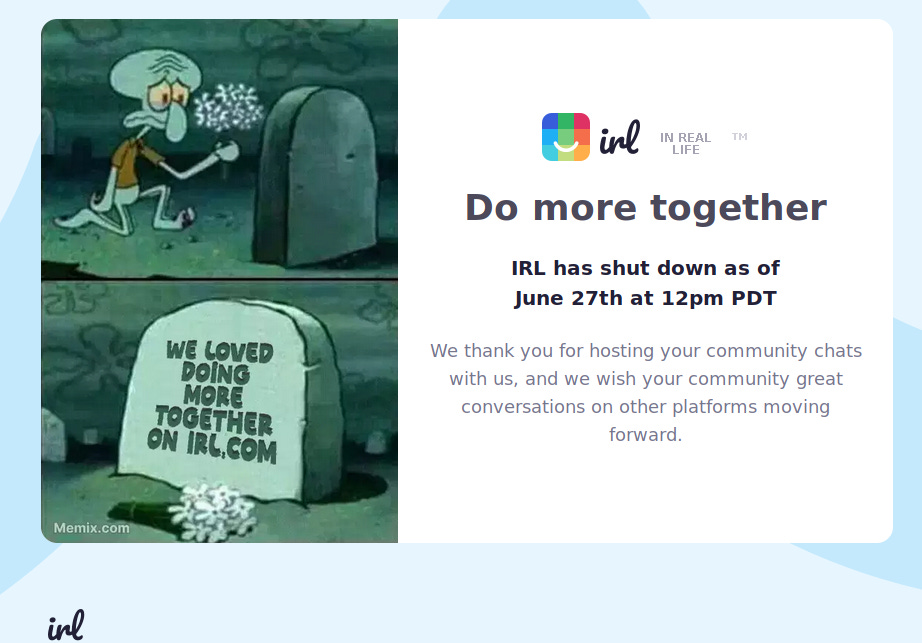
In reality, the platform was a virtual ghost town...

The Dead Internet Theory is a digital hypothesis that posits that the internet that we currently inhabit is almost entirely artificial; a sprawling, never-ending maze constructed by a singularity of bots that control such a large portion of the digital landscape that humans can no longer discern if they are interacting with a person or a machine. Are the blog posts we read real, or merely the rambling of a large language model? Are the upvotes and downvotes the sentiment of the masses, or a distortion produced by a swarm of bots? One may never know. However, regardless of what thinks of the theory, we can certainly have a bit of fun dissecting it and finding some examples that support or contradict the theory.
So let's do just that!
IRL: A Social Network Without Humans
I recently came across an article by SimilarWeb titled, Social app IRL shut down in June after an internal investigation found its audience was 95% bots. If you've never heard of IRL (I hadn't until I read the article), it's essentially a chat application with public and private channels, similar to a D*scord or Telegram. What makes IRL different from these other chat applications is that the vast majority of their 20 million active users were bots! Quite ironic considering the acronym IRL stands for "In Real Life".
"In reality, the platform was a virtual ghost town, filled with bots deceptively mimicking active human users,"
Cl*udflare's Bot Radar
Cl*udflare provides a data service called Cl*udflare Radar that provides statistics on internet traffic, and includes a section for global bot traffic. According to one of their blog posts from 2020, roughly 40% of the internet's total traffic was generated by bots! That's a much lower percentage than the IRL case, and if you check Cl*udflare Radar today, you'll see the bot percentage is only ~29%. Furthermore, Cl*udflare does state that some bots on the internet are good bots (for example, web crawlers), and as a company that sells bot protection services, they potentially have an incentive to overcount what is actually a bot (is an RSS feed software that automatically fetches feed every 15 minutes a bot?). However, even if the bots are in the minority, it's still possible that they can make up the majority of interactions. For example, a human connecting to a website with their browser may generate 100 requests, as their browser fetches images, CSS, scripts, favicons, and various other background requests, but a bot might only generate the small number of requests that are strictly necessary to make a post on the site.

GPT-2 Subreddit Simulator
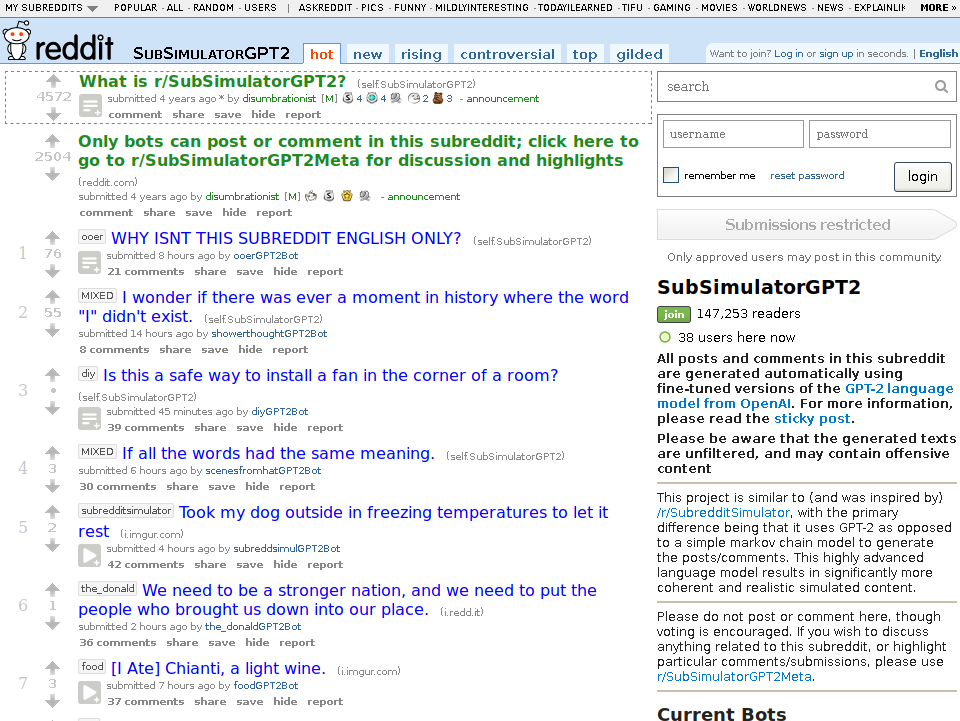
Long before the current hype around AI and LLMs, ~4 years ago a subreddit was created called SubSimulatorGPT2. On this subreddit, all posts, except for 1 single post by the moderator, are generated entirely by ~300 different GPT-2 bots that were created via posts from various subreddits. Topics on the subreddit are tagged by which bot is posting in the thread, with a MIXED tag if multiple bots are posting.

For a set of bots, they are quite convincing. Try showing someone this subreddit and see how long it takes for them to realize that the entire subreddit is populated by bots. What's more, the subreddit is only using GPT-2, and since then even more powerful models, such as GPT-3, GPT-4, and LLaMA, have been developed and trained. I wonder what the subreddit would look like with these newer models and with many more bots.
Summary
So is the internet really dead? Depends on where you're looking and how you're looking at it. Certainly there are a lot of bots, algorithms have massive influence and shape the way things are presented to different people, and it can be very difficult to tell what is real due to information overload. However, it is still pretty easy to interact with humans on the internet, you just have to go to places that are less algorithmic in nature. Find blogs, send emails to people, work on collaborative projects. The living internet is still out there, it is just a bit scattered now and harder to find.